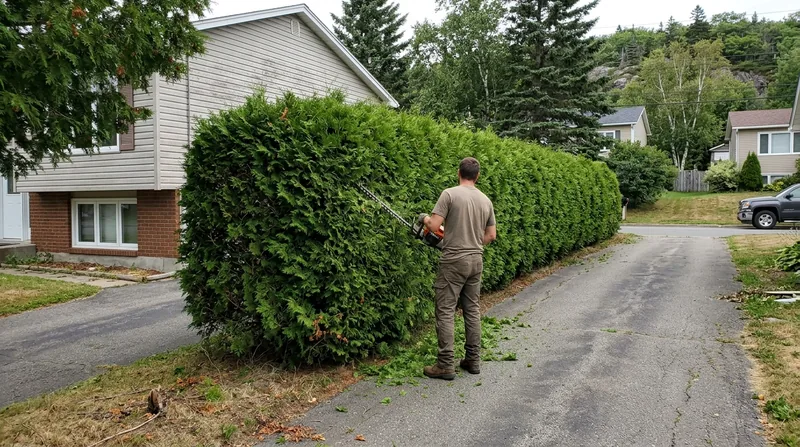




In Saint John, a cedar hedge is often the first thing a neighbour sees, and the last thing anyone has time to trim. When a hedge on a property line in the Lower West Side or Fairville grows out of reach, it stops screening and starts shading the lawn, crowding the walkway and pushing into a driveway. Cedar hedge trimming in Saint John is a job we handle with a straight line, a measured face and a clean property at the end. Our crews work with ISA Certified Arborists on staff, a local, fully insured company operating since 2014. We trim hedges in late spring and summer, when the new growth has hardened and the shape holds through the winter. Every pile of clippings leaves with us. You can see how this fits with the rest of our work on the tree trimming service page.
Why a cedar hedge needs trimming, not just cutting back
A cedar hedge is a living wall, and it responds to how it is cut. Shear it flat on top and vertical on the sides, and the top takes the light while the lower branches thin out and turn brown. Leave it for three or four years, and the inner wood is bare, with no green left to regrow. On the ravine lots and tight backyards across the Saint John area, a hedge often sits against a fence, a shed or a property line, which limits how much room a ladder has.
- We cut a slight batter, with the top narrower than the base, so sunlight reaches the lower branches.
- We trim the sides and the top in one pass to keep a straight, square face along the property line.
- We remove dead and brown patches where the hedge has already thinned, rather than hiding them under a flat cut.
- We clear the clippings and rake the bed, so the lawn and walkway are left clean.
A hedge trimmed this way keeps its density from the ground up, which is what makes it a screen instead of a row of bare stems.
Key fact: A 15-metre cedar hedge along a property line in Grand Bay-Westfield, trimmed on three faces and standing about 2.4 metres tall, is normally a half-day job for a two-person crew. The same hedge left for three seasons can take a full day, because we bring it back in stages instead of cutting it to the bone in one pass.
For the provincial rules that apply to trees and property lines, the Government of in Saint John and the surrounding area publishes the relevant material on property boundaries and neighbour disputes.
How we bring an overgrown hedge back into line
Most hedges we see in Saint John West have not been touched in years. Cutting them back hard in a single visit leaves a wall of brown wood and a hedge that may never fill in again. We bring an overgrown cedar hedge back over two or three seasons, taking a little off each face each time, so the green growth stays ahead of the cut. On a hedge that is still healthy, one visit is enough to set the line and the shape.
- We walk the property line and check the height, the width and the clearance to fences, sheds and the private service entrance.
- We set a string line along the top and the face, so the finished hedge is straight from one end to the other.
- We trim the sides first, then the top, cutting back to green growth wherever it exists.
- We shape the top slightly narrower than the base, so light reaches the lower branches.
- We collect every clipping, blow off the walkway and driveway, and leave the bed raked.
That sequence keeps the line true and the hedge healthy, and it means the property is clean when we drive away.
Key fact: A hedge in the Lower West Side that had grown to 3 metres and was pressing against a garage wall came back to 2.2 metres over two visits, one in June and one in August. The homeowner kept the screen, the garage wall was clear, and no section went brown. Hedges in the older post-war subdivisions often need this staged approach because they were planted close to the structures.
If the hedge sits along a property line you share with a neighbour, it helps to agree on the finished height before the crew arrives. Our service areas page shows the municipalities we cover, including Grand Bay-Westfield.
Trimming methods we use on cedar hedges
The right method depends on the height of the hedge, the space behind it and how much room the crew has to work. A low hedge along a front walk is a different job from a 3-metre screen against a ravine slope. We choose the method on site, after looking at the access and the condition of the cedar.
| Method | Description | Context |
|---|---|---|
| Hand shears and loppers | Clean cuts on the face and the top, with the line set by string | Hedges under 2 metres, tight beds and narrow side yards |
| Powered hedge trimmer | Fast, even cut on long runs and straight faces | Long property lines and uniform hedges in good condition |
| Staged reduction | Height and width reduced over two or three visits | Overgrown hedges with bare inner wood |
| Ladder and pole work | Top and upper face cut from a ladder or with pole tools | Hedges over 2.5 metres, slopes and ravine lots |
| Clipping removal | All clippings bagged and taken off the property | Every job, with the walkway and driveway blown clean |
On a hedge that is still healthy, the powered trimmer and the string line do most of the work. On a hedge that has been let go, the staged reduction is what protects the screen.
What surrounds the work: permits, clearance and clippings
Cedar hedge trimming on a private property rarely needs a municipal approval, because the hedge is not a tree and the work stays on your side of the line. The City of Saint John may require a permit for a private tree removal, and an arborist report normally supports that application, but that rule applies to trees, not to a cedar hedge cut back to shape. When a hedge has grown into a tree-sized cedar and the owner wants it gone, we check the rule before any saw starts. Rules and thresholds differ from one municipality to the next across the Saint John area, so we confirm the local requirement rather than assume it.
Clearance matters near the private service entrance, the wire that runs from the pole to your house. We keep the required approach distance and never work on the public distribution network operated by NB Power; a hedge or branch touching those lines is referred to NB Power. Clippings leave with us on every visit, and any material that can be chipped goes through our brush chipping service. For a hedge that has died out and needs replacing, our tree planting and transplanting service covers the replant. If a storm has split the hedge or brought a limb down on it, our storm damage cleanup service handles the removal and the cleanup. Pricing for hedge work sits on our pricing page, and we confirm the figure on site before any cut.
Call (506) 719-5415 to book a free estimate. A crew will measure the hedge, check the access and give you a written price for the trim, the clipping removal and any staged work the hedge needs.
Prices Cedar Hedge Trimming in Saint John — Indicative pricing
| Service | Price | Details |
|---|---|---|
| Cedar hedge trimming, up to 2 metres | From $275 | Three faces cut, line set by string, clippings removed |
| Cedar hedge trimming, 2 to 3 metres | From $425 | Ladder work, top and sides, clippings removed |
| Overgrown hedge, staged reduction | From $650 | First visit of a two- or three-season plan |
| Long property line, over 30 metres | From $750 | Powered trimmer, straight face, full cleanup |
| Travel | Included | in Saint John and the surrounding area |
| Estimate | Free | Written price on site, reply within 24 hours at (506) 719-5415 |
Indicative prices; free, personalized estimate within 24h at (506) 719-5415.