



Planting a tree in Saint John is not a matter of digging a hole and dropping a nursery pot into it. Coastal winds off the Bay of Fundy, wet springs, rocky ground and the heavy clay that shows up across the region all decide whether a young tree establishes or fails within two seasons. Tree planting and transplanting in Saint John means matching the species to the site before the shovel touches the ground, then setting the root flare at the correct depth and watering through the first two summers. We have planted and moved trees here since 2014, and our ISA Certified Arborists work from the soil up. If you are still deciding between planting and removing a declining specimen, our tree removal service covers that side of the decision.
Why planting correctly matters more here than anywhere
A tree planted too deep in in Saint John and the surrounding area clay will girdle itself within a decade, and a spruce set against a west-facing wall in Saint John will be burned by salt wind every winter. The species list matters as much as the technique: silver and sugar maple, red and white oak, birch and Norway spruce perform well when the site suits them, while ash is now a poor bet across the province because of the emerald ash borer. Getting the choice right the first time avoids a removal invoice later.
- We test drainage and soil texture before recommending a species.
- We select nursery stock with a single straight leader and a visible root flare.
- We plant at the depth the root collar demands, not the depth of the pot.
- We stake only when wind exposure or a bare-root transplant requires it.
Every planting plan we write names the species, the stock size and the reason it suits your ground.
Key fact: a 2 metre bare-root sugar maple planted in Grand Bay-Westfield in early May needs roughly 40 litres of water per week through its first summer. A nursery pot of the same height left unwatered in Saint John clay can be dead by August.
For the provincial guidance on planting and species selection, the in Saint John and the surrounding area Department of Natural Resources publishes reference material that we use when advising homeowners.
How we plant and transplant, step by step
Our crews work from a written plan, and the plan starts with a site visit. We mark the planting position against the house, the driveway and any private service entrance, then check what lies below grade. On ravine lots in the Saint John area, access and slope change the method before anything else does. A transplant with a full root ball is moved with the equipment the site allows, not the equipment we would prefer.
- We inspect the site for underground services, drainage and sun exposure.
- We match the species and stock size to the space the tree will occupy at maturity.
- We dig the planting hole wider than the root ball and leave the subsoil roughened.
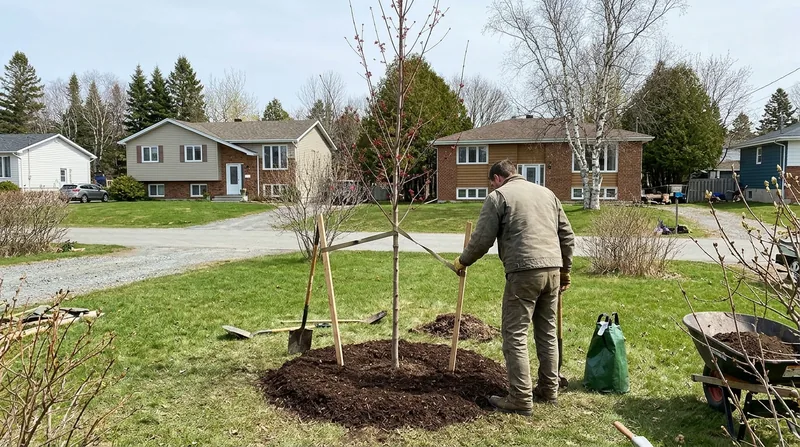
- We set the tree so the root flare sits at grade and backfill in lifts.
- We water to settle the soil, mulch to 7 centimetres and keep mulch off the trunk.
- We stake and tie only where wind or a bare-root transplant justifies it.
Transplants are lifted with a root ball sized to the trunk calibre, wrapped and moved the same day wherever possible.
Key fact: moving a 3 metre cedar hedge section on a property line in Saint John West takes a root ball roughly 60 centimetres across and a machine small enough to pass a standard gate. We confirm gate width during the site visit, not on the day of the job.
If the ground is being cleared for a new planting scheme, our lot clearing service handles the removal of unwanted stock before we plant.
Methods we use, and when each one applies
Not every planting job calls for the same approach. A container-grown ornamental in a tight backyard is a different operation from a balled-and-burlapped maple on an open lawn. The table below sets out the four methods we use most often across the Saint John area.
| Method | Description | Context |
|---|---|---|
| Container planting | Root ball set at grade, backfilled in lifts, mulched and watered in. | Small ornamentals and street trees in established Saint John neighbourhoods. |
| Balled and burlapped planting | Larger stock moved with a full root ball, wire basket removed at the collar. | Feature maples and oaks on open lawns in Grand Bay-Westfield. |
| Bare-root transplant | Lifted in dormancy, roots kept damp, planted before bud break. | Native stock on ravine lots where weight and access are limiting factors. |
| On-site transplant | Existing tree lifted with a root ball and reset in a new position the same day. | Rearranging mature garden stock during a renovation in Saint John. |
The method follows the site and the species, and we confirm it in writing before any work starts.
What governs a planting job on private property
Planting rarely needs a permit, but the surrounding rules still apply. The City of Saint John may require a permit for a private tree removal, and where a removal is part of a replanting plan, the application is normally supported by an arborist report. Rules and thresholds differ from one municipality to the next across the Saint John area, so we check the local requirement before we schedule anything. Near a private electrical service entrance, the wire running from the pole to your own house, we respect the required approach distances and keep our equipment clear. A tree touching the public distribution network is referred to NB Power, and we never work on that network.
Residues leave the site the same day. Brush and limbs go through the chipper, and the chips can stay on your beds or leave with us. Any removed stump is ground below grade and the hole is backfilled with the grindings. We document the work with photographs so you have a record of what was planted, where, and at what depth.
Our crews carry liability coverage, and a certificate is available on request before work begins. For a written scope and a firm number, the pricing page sets out how we build a quote, and you can reach the office at (506) 719-5415.
Species selection for coastal winds and wet ground
The right tree in the wrong place becomes an expensive problem. Along exposed sections of Saint John, salt-laden wind and winter burn rule out several species that thrive inland. On the wetter ground found in low parts of the city, drainage decides whether a root system survives its first spring. We shortlist species against your soil, your exposure and the space the canopy will need in twenty years.
- Norway spruce suits windbreaks on larger lots where the root run is unrestricted.
- Red and white oak suit deeper soil and tolerate the region's freeze-thaw cycles.
- Birch performs on cooler, moister ground but suffers on hot, exposed sites.
- Silver and sugar maple work well where the lawn is open and the soil stays moist.
- Black locust establishes quickly on poor, rocky ground and fixes nitrogen.
We avoid ash on new plantings while the emerald ash borer remains active, and we say so plainly rather than sell stock that will not last.
Where an existing tree needs structural work before it can be kept, our tree pruning service covers the corrective cuts, and our arborist report service provides the written assessment a permit application may require.
Timing a planting or a transplant in the Saint John area
Bare-root and transplant work belongs in dormancy, from late fall to late winter, when the tree is not spending energy on leaves. Container and balled-and-burlapped stock can go in during spring once the frost has left the ground, and early autumn gives roots a second window before freeze-up. Summer planting is possible with irrigation, but it costs more in water and attention. We schedule around the season rather than against it.
- We lift and reset transplants between late October and early April.
- We plant container stock from May through June and again in September.
- We water new trees through the first two growing seasons.
- We inspect stakes and ties after the first winter and remove them once the tree stands on its own.
A tree planted in the right week needs far less corrective work later, which is why we book dormancy work first.
To arrange a site visit in Saint John or Grand Bay-Westfield, call (506) 719-5415 or use the contact page to request a free estimate.
Prices Tree Planting & Transplanting in Saint John — Indicative pricing
| Service | Price | Details |
|---|---|---|
| Container tree planting | From $225 | Small ornamental or street tree, hole prepared, planted, mulched and watered in. |
| Balled and burlapped planting | From $475 | Larger stock moved with a full root ball, staked where needed. |
| On-site transplant | From $650 | Existing tree lifted with a root ball and reset the same day. |
| Bare-root native planting | From $325 | Dormancy planting on ravine or restricted-access lots. |
| Site visit and written plan | Free | Species shortlist, position, access and depth confirmed in Saint John and the surrounding area. |
| Free estimate | Free | Reply within 24 hours at (506) 719-5415. |
Indicative prices; free, personalized estimate within 24h at (506) 719-5415.