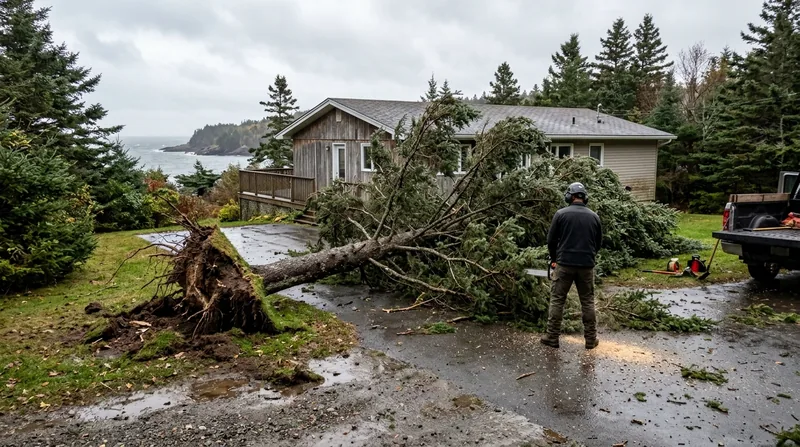




When a tree comes down on a roof, a car or a driveway in Saint John, the first hour matters. Emergency tree removal in Saint John is the work our crews handle year-round, most often after an ice storm in January or a windstorm in August. Silver and sugar maple, red and white oak, ash killed by the emerald ash borer: the species around here grow tall and heavy, and a mature trunk lying across a fence does not wait. We are a local, fully insured company working since 2014, with ISA Certified Arborists on staff. One call to (506) 719-5415 gets a crew moving, a hazard stabilized and the damage documented for your insurer. If the tree is still standing but weakened, a look at our tree removal service explains the planned route.
Why a downed tree cannot wait
A leaning trunk under tension, a limb resting on a service entrance wire, a root plate lifted out of saturated clay: each of these can shift again within hours. in Saint John and the surrounding area freeze-thaw cycles make it worse, because water refreezes in the cracks and pushes the wood further. The risk is not only the tree itself. It is the fence, the shed, the vehicle and the person who walks under it to take a closer look.
- A split trunk can finish falling on its own during the next gust, so we secure the area before any cut.
- A limb resting on your private service entrance wire needs the utility involved, and we coordinate that call rather than touch the line.
- Water pooling against a foundation after a root plate lifts can enter a basement within a day, so we clear the debris path quickly.
- Insurance claims move faster with dated photos and a written description, which we prepare on site.
Every one of these points is a reason to call rather than to wait for daylight and a calmer forecast.
Key fact: after the 2023 ice storm, several homes in Grand Bay-Westfield needed a maple removed from a porch roof the same night. Crews that arrived without a documented assessment lost days with the insurer. Ours arrived with photos, measurements and a written hazard note.
For the rules that apply to private trees, the City of Saint John publishes its own guidance, and the municipal planning pages are the reference to check before a removal is scheduled.
How our crews stabilize and remove a storm-damaged tree
The sequence is always the same, and it is what keeps the work safe when a trunk is under load. We assess from the ground first, then from above only if the structure allows it. Nothing is cut until the load path is understood and the drop zone is clear.
- We take the emergency call and ask what the tree is resting on, so the first crew arrives with the right rigging.
- We secure the perimeter, move people and vehicles back and identify any private service entrance near the work zone.
- An ISA Certified Arborist assesses the trunk, the root plate and the remaining canopy before any cut is planned.
- We remove the weight in controlled sections, using ropes and a lowering system where a free drop is unsafe.
- We cut the wood to length, chip the brush and leave the site clear of debris.
- We hand over photos and a written record of the damage for your insurer.
That order is not negotiable, and it is why a crew can work a tight backyard in Saint John West without damaging the neighbouring fence.
Key fact: a Norway spruce that came down across a driveway in Fairville took four hours to clear, including rigging over a parked car. The same job on an open lot would have taken two. Access, not tree size, usually sets the schedule.
When the hazard is gone but the stump remains, our stump grinding service takes over once the ground is stable.
Methods we use, and when each one applies
No two storm calls look alike, so the method follows the situation rather than a standard script. A tree leaning over a shed is not handled like a trunk already on the ground. The table below shows the four approaches we use most often in the Saint John area.
| Method | Description | Situation |
|---|---|---|
| Sectional rigging | The tree is lowered in controlled pieces on ropes. | A trunk over a roof, a fence or a tight backyard. |
| Controlled felling | The tree is dropped in one piece into a clear fall zone. | An open ravine lot or a cleared area with room to fall. |
| Limb removal under tension | Broken limbs are cut in sequence to release stored energy safely. | A tree split but still standing after a windstorm. |
| Root plate stabilization | The lifted root mass is secured before the trunk is cut. | Saturated clay after heavy rain, common on ravine lots. |
Each method is chosen on site by the arborist, and the choice can change once the first cut reveals the condition of the wood.
What surrounds the job: permits, distances and debris
Three practical points frame every emergency removal in the region. The first is municipal: the City of Saint John may require a permit for a private tree removal, and the application is normally supported by an arborist report. Rules and thresholds differ from one municipality to the next across the Saint John area, so we check before the crew arrives when the situation allows it. The second is electrical: approach distances must be respected near private service entrances, and the public distribution network of NB Power is never touched. A tree touching the public lines is referred to NB Power, and we say so on the call. The third is debris: brush is chipped on site, wood is cut to length and left for firewood or hauled away, and the driveway is swept before we leave.
Where a removal needs paperwork, our arborist report service provides the written assessment the application requires. For larger grounds, storm damage cleanup covers the wider property once the immediate hazard is down.
When to call, and what it costs
Emergency removals run year-round and peak with ice storms and summer windstorms, so there is no wrong season to call. Outside those peaks, a tree that has shifted or dropped a large limb still deserves the same response, because the next storm does the rest. Pricing depends on access, height, the structure the tree is resting on and whether rigging is needed.
- A small tree down in an open yard is the simplest call and the lowest cost.
- A large maple over a roof in Saint John West requires rigging, and the price reflects the time and equipment.
- A ravine lot with steep access adds handling time for every piece of wood.
- Chipping, hauling and stump grinding are quoted separately so the invoice stays clear.
We give a free estimate before any work begins when the site can be assessed safely, and we confirm the scope in writing. Call (506) 719-5415, or use the contact page to book an assessment.
Prices Emergency Tree Removal in Saint John — Indicative pricing
| Service | Price | Details |
|---|---|---|
| Small tree down, open yard | From $275 | Cut, chipped and cleared, no rigging required |
| Large tree over a structure | From $850 | Sectional rigging, arborist assessment and documentation |
| Complex access or ravine lot | From $1,200 | Steep ground, tight gate or long carry distance |
| Stump grinding after removal | From $150 | Quoted separately, depth- and diameter-dependent |
| Travel | Included | In Saint John and the surrounding area |
| Estimate | Free | Reply within 24 hours at (506) 719-5415 |
Indicative prices; free, personalized estimate within 24h at (506) 719-5415.