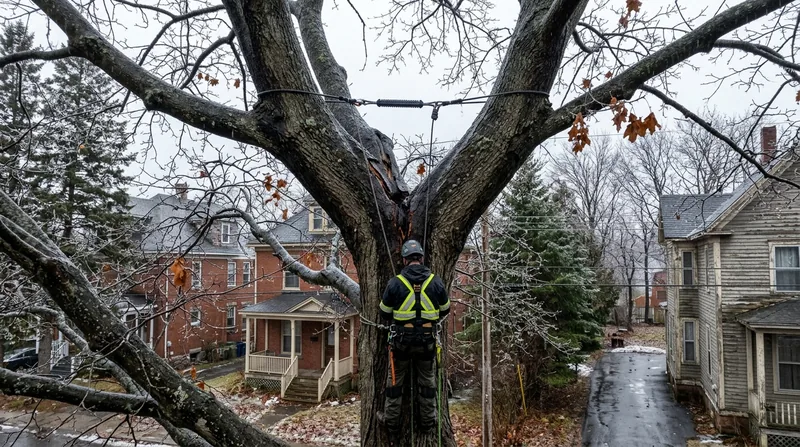




Tree cabling and bracing in Saint John is the work that keeps a mature maple or oak standing when its structure starts to fail. The city's post-war neighbourhoods are full of large silver maples and red oaks with co-dominant stems and narrow forks, and the freeze-thaw cycles of in Saint John and the surrounding area open those seams a little wider every spring. Add a ravine lot off the Lower West Side with steep access, or a tight backyard in Fairville reachable only through a standard gate, and you have trees that are worth saving but no longer safe to leave alone. Our ISA Certified Arborists inspect the crown, the root flare and every union before recommending a cable or a rod. We have been doing this work since 2014, and we only install hardware when the tree is sound enough to keep. For a free estimate, call (506) 719-5415 or review our full pricing grid.
Why cabling and bracing matter for mature trees in the Saint John area
A tree that splits in a windstorm rarely gives a second warning. The species that dominate local canopies, silver maple, sugar maple, red oak and white oak, often grow with two or three leaders competing for dominance. Each union carries included bark, a weak seam that rain and frost work into year after year. Cabling and bracing does not heal that seam, but it shares the load and limits the movement that tears it apart.
- We inspect every fork from the ground and from within the crown to grade the severity of the defect.
- We check the root flare and soil for decay, because a cable cannot save a tree with a failing base.
- We measure the spread and the height of the leaders to size the cable and the anchors correctly.
- We document the defect with photos so you have a record for your insurer or for a later arborist report.
The inspection decides the outcome: some trees need hardware, some need pruning, and some are past the point where either helps.
Key fact: a mature silver maple in Grand Bay-Westfield with a split leader over a driveway is a typical candidate. A single static cable in the upper crown, installed with two through-bolts, usually runs between $450 and $850 depending on height and access.
For the wider picture on how structural defects are assessed, the International Society of Arboriculture publishes plain-language guidance on tree risk evaluation that we follow on every site.
How we install a cable or a brace
Every installation follows the same sequence, whether the tree stands in a backyard in Saint John West or on a ravine lot with steep access. The goal is to keep the hardware out of sight, keep the tree's natural movement, and make sure the anchors sit in sound wood rather than in a pocket of rot.
- We climb and inspect the union at close range, sounding the wood and checking for cracks that run below the bark.
- We choose the hardware: a flexible steel cable for a dynamic union, a steel rod for a split that needs rigid support.
- We drill and set the anchors at the correct height, usually two-thirds of the distance from the defect to the top of the crown.
- We tension the cable so the leaders can still move in light wind but cannot spread in a storm.
- We prune deadwood and reduce end weight so the hardware is not fighting a load it was never sized for.
- We photograph the finished install and log the hardware for future inspections.
Most residential installations take half a day, and the tree stays in service the whole time.
Key fact: a red oak with a narrow fork over a shed in a tight Saint John backyard can be reached through a standard gate. A two-cable system with end-weight reduction typically lands between $700 and $1,200, and the crew leaves the yard clean.
If the inspection shows the union is too far gone, we say so and move the conversation to tree removal instead of selling hardware that will not hold.
Cables, rods and support systems compared
Not every weak tree needs the same solution. The choice depends on the type of defect, the species, the age of the wood and what sits underneath the crown. The table below shows how we match the hardware to the situation.
| Method | Description | Typical context |
|---|---|---|
| Static cable | A steel cable tensioned between two leaders to limit spread. | Mature maple or oak with a co-dominant stem over a roof or driveway. |
| Dynamic cable | A flexible cable that allows normal sway while capping extreme movement. | Younger trees and species that react badly to rigid support. |
| Through-rod | A steel rod drilled through a split union to hold the two halves together. | A vertical crack or a fork that has already begun to open. |
| Cable plus pruning | Hardware combined with end-weight reduction and deadwood removal. | Large crowns where the load itself is the main problem. |
We select the method after the inspection, never before, because the wrong hardware shortens a tree's life instead of extending it.
Permits, setbacks and cleanup around the work
The City of Saint John may require a permit for a private tree removal, and the application is normally supported by an arborist report. Cabling and bracing is not a removal, but the inspection that precedes it often produces the documentation a homeowner needs for a related application. Rules and thresholds differ from one municipality to the next across the Saint John area, so we confirm the local requirement before any work is scheduled. Near a private electrical service entrance, we respect the required approach distances, and any tree touching the public distribution network is referred to NB Power. We never work on that network. All brush and offcuts are chipped and removed, and the site is left clean.
If the inspection calls for a formal document, our arborist report service covers the assessment in the format the city expects.
When to schedule cabling and bracing
The best window for structural work is dormancy, from late fall to late winter, when the crown is bare and the wood is at its most visible. Cabling can be installed year-round, but a dormant inspection shows cracks and included bark that summer foliage hides. Ice storms and summer windstorms drive most emergency calls, and a tree that has already lost a limb is a candidate for immediate assessment. If a storm has left a hanging limb, call (506) 719-5415 and keep the area clear until the crew arrives. For related structural work, see our tree pruning page.
We serve Saint John and Grand Bay-Westfield, and we confirm access and scheduling when you call. Our crews are insured, and our ISA Certified Arborists are on staff.
Prices Tree Cabling & Bracing in Saint John — Indicative pricing
| Service | Price | Details |
|---|---|---|
| Cable installation (single) | From $450 | One static or dynamic cable in a co-dominant stem includes inspection and cleanup |
| Cable installation (multiple) | From $700 | Two or more cables with end-weight reduction, priced by height and access |
| Through-rod bracing | From $550 | Steel rod through a split union, with cable support where needed |
| Complex or high-access job | On assessment | Ravine lots, tight backyards and tall crowns, free on-site evaluation |
| Travel | Included | In Saint John and the surrounding area |
| Estimate | Free | Reply within 24 hours at (506) 719-5415 |
Indicative prices; free, personalized estimate within 24h at (506) 719-5415.