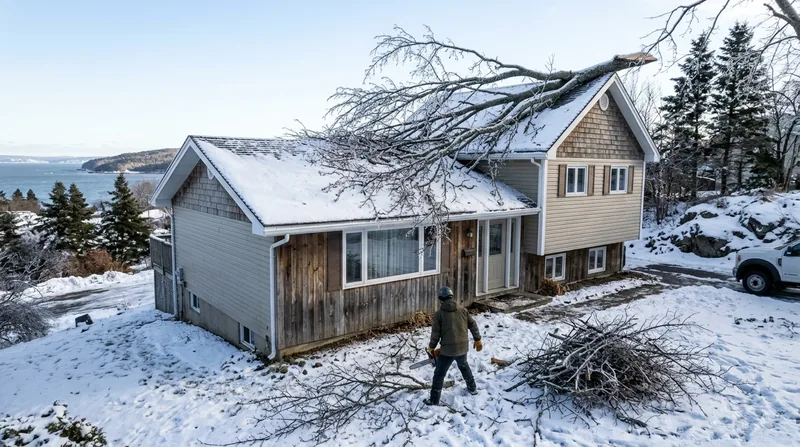




When a post-tropical storm tracks up the Bay of Fundy, the damage in Saint John rarely looks the same from one street to the next. Wind funnels through the steep ravines above the Lower West Side, mature maples in post-war subdivisions lose limbs onto roofs and driveways, and cedar hedges along property lines get torn open. Storm damage cleanup in Saint John is the work of making a property safe again after that kind of event: removing hanging limbs, clearing debris, and assessing trees that have split or uprooted. Our crews have handled storm calls across the city since 2014, and our ISA Certified Arborists assess every damaged tree before a saw goes into it. We document what we find for your insurer and leave the yard clear. If a tree is touching the public distribution network, that call belongs to NB Power, not to us.
Why storm damage needs a fast, structured response
A tree that has lost half its crown is still standing under load, and the next wind event decides what happens. Split leaders, cracked crotches and root plates lifted out of saturated clay are the failures we see most after an ice storm or a summer windstorm. Waiting a week rarely makes the situation safer, and it often makes the cleanup larger.
- We remove hanging limbs that threaten roofs, vehicles and walkways before they fall.
- We assess split and uprooted trees to decide whether cabling, bracing or removal is the right call.
- We clear debris from lawns, driveways, fences and fence lines so the property is usable again.
- We chip brush on site and leave the wood or haul it away, depending on what you prefer.
Every job starts with an assessment, because a storm-damaged tree is not a normal pruning job and the wrong cut can finish it off.
Key fact: After post-tropical storm Lee in 2023, most of our calls in Saint John West involved single large limbs down on a roof or a fence, not whole trees. Those jobs typically run from $450 to $1,200 depending on access and the height of the work.
Environment Canada issues the wind and freezing rain warnings that give homeowners a head start, and its weather alert resources are worth checking before a storm rather than after.
How our crews handle a storm call
Storm work is sequenced, not improvised. We start with what is still hanging, because that is what hurts people, then move to the trees that are compromised but standing, then to the debris field. On ravine lots with steep access, the sequence changes: we rig from the top down and never let cut material run downhill toward a structure.
- We take the call at (506) 719-5415 and ask what is down, what is hanging and whether anything is touching a service entrance.
- An ISA Certified Arborist assesses the tree on site and identifies the failure point before any cutting begins.
- We set up rigging and drop areas, then remove hanging limbs and unstable tops in controlled sections.
- We decide with you whether a split tree can be saved with cabling and bracing or has to come down.
- We clear and chip the debris, then walk the property with you before leaving.
That order matters on tight backyards reachable only through a standard gate, where every piece has to leave the way the crew came in.
Key fact: A Norway spruce that lost its top in a windstorm on a Grand Bay-Westfield lot took four hours to bring down in sections over a shed, with the wood left cut to length at the curb. The homeowner kept the firewood and we chipped the rest.
When the damage is severe enough that the tree has to come out entirely, the work moves to our emergency tree removal service, which follows the same assessment steps with removal as the outcome.
Matching the method to the damage
Not every storm-damaged tree needs the same treatment, and the assessment determines which method applies. A cracked crotch on a mature oak is a different problem from a birch leaning over a fence after the ground sat wet for a week. The table below shows how we approach the common cases.
| Method | Description | Typical situation |
|---|---|---|
| Hanging limb removal | Controlled removal of broken limbs still attached to the crown, rigged to avoid the drop zone. | Limb down on a roof, fence or driveway after a windstorm. |
| Cabling and bracing | Steel cables and rods installed to support a split crotch or codominant leader. | Mature maple or oak with a crack but a sound trunk. |
| Sectional removal | Tree taken down in pieces from the top, with rigging over structures or tight access. | Uprooted or split tree that cannot be saved, close to a house. |
| Debris clearing and chipping | Brush and broken wood collected, chipped on site and either left or hauled away. | Yard covered in branches after a storm, no standing hazard left. |
Whichever method applies, the goal is the same: a safe property and a clean yard, with the reasoning explained to you before the work starts.
Permits, safety distances and debris in the Saint John area
Storm damage does not suspend the rules. The City of Saint John may require a permit for a private tree removal, and the application is normally supported by an arborist report; we prepare that report when a damaged tree has to come down. Rules and thresholds differ from one municipality to the next across the Saint John area, so we confirm what applies to your address before the crew arrives.
Near private electrical service entrances, we respect approach distances and never work on the public distribution network operated by NB Power. If a tree is touching or resting on the public lines, we stop and the utility handles it. Debris is chipped on site where access allows, and the wood is either left cut to length for you or hauled away; on tight lots we carry material out through the same gate the crew entered by.
What storm cleanup costs in Saint John neighbourhoods
Pricing depends on the number of trees, the height, the access and how much material has to leave the property. A single limb on a roof is a short job; an uprooted spruce leaning over a shed on a ravine lot is a different day. We give a free estimate on site before any work begins, and the figure does not move unless the scope changes.
- Small cleanup, one limb or a few branches: from $275.
- Medium job, several limbs or one compromised tree: typically $450 to $1,200.
- Large job, uprooted tree over a structure or multiple trees down: quoted after assessment.
- Debris chipping and hauling: included in the quote or priced separately if you keep the wood.
Our full pricing grid sets out the ranges we work from, and the estimate confirms the number for your property.
Key fact: In the older neighbourhoods around the Lower West Side, a mature street tree that drops a major limb often needs a second look at the remaining crown. We quote that follow-up pruning at the same visit rather than leaving it as a separate call later.
If the damage is limited to dead wood in the crown rather than a fresh break, the work belongs with our deadwood removal service, which is scheduled rather than emergency work.
After the storm: what to check before you call
Once the wind drops, a quick walk around the property tells you a lot. Look up before you look down, and keep your distance from anything that is still hanging or leaning. A tree that has lifted its root plate looks stable from the trunk but is already moving under the soil.
- Check the roof, eaves and service entrance for limbs resting on them, and stay back from anything near the wires.
- Look for cracks in the crotch, split leaders and soil lifted around the base of a tree.
- Keep children and pets away from leaning trees and from the drop zone until the assessment is done.
- Photograph the damage before cleanup for your insurer, and call (506) 719-5415 to book the assessment.
A short call now is cheaper than a second storm finishing a tree that was already compromised.
Our crews work across Saint John and Grand Bay-Westfield, and the service areas page lists the municipalities we cover. If you are comparing companies, the arborist report service is often what separates a documented removal from an argument with the city later.
Prices Storm Damage Cleanup in Saint John — Indicative pricing
| Service | Price | Details |
|---|---|---|
| Small cleanup (one limb, a few branches) | From $275 | Hanging limb removal, debris cleared and chipped |
| Medium cleanup (several limbs or one compromised tree) | $450 to $1,200 | Assessment, rigging, debris clearing and chipping |
| Large cleanup (uprooted tree over a structure, multiple trees) | Quoted after assessment | Free on-site evaluation before work begins |
| Travel | Included | In Saint John and the surrounding area |
| Estimate | Free | Reply within 24 hours at (506) 719-5415 |
Indicative prices; free, personalized estimate within 24h at (506) 719-5415.