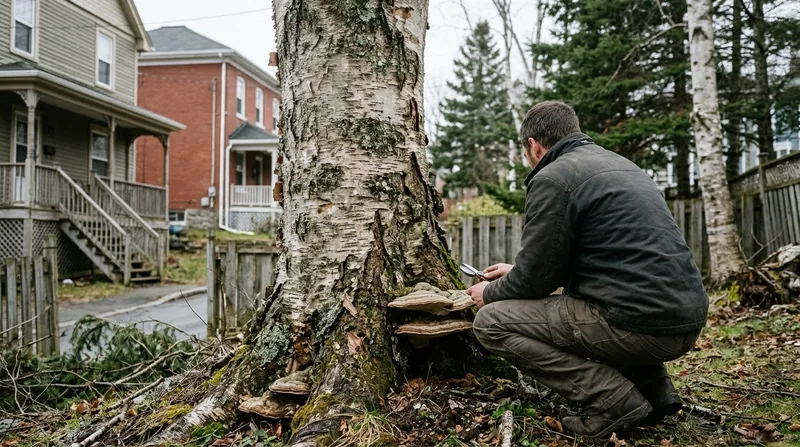




Tree disease in Saint John rarely announces itself with a single dramatic symptom. It builds slowly: a silver maple on the Lower West Side that leafs out thinner each spring, a white birch near Rockwood Park with a dead top, a row of cedars along a Fairville property line turning brown from the inside out. Our tree disease treatment in Saint John starts with a proper diagnosis by an ISA Certified Arborist, because most of the damage we are called out to see has been misread for a season or two. Coastal salt spray, thin soil over rock, freeze-thaw cycles and a short growing season all produce symptoms that look like disease but are not, and the reverse is just as common. We identify what is actually happening to the tree, then treat it or recommend removal when the structure can no longer be made safe. If a tree has already died back, our tree removal service handles the next step.
Why tree disease treatment matters more on the coast
Saint John sits on a harbour with salt in the air, and the growing conditions change block by block. Trees on exposed lots take wind and salt spray; trees on ravine lots root into thin soil over bedrock and dry out fast in August. Both situations weaken a tree's natural defences, and weakened trees are where fungal cankers, leaf diseases and wood decay take hold. Ash across the region are also dying from the emerald ash borer, which is a separate problem from disease but often gets confused with it.
- We diagnose the actual cause before recommending any treatment, because salt damage and drought stress are routinely mistaken for fungal disease.
- We treat leaf diseases and cankers with targeted applications timed to the infection cycle, not on a fixed calendar.
- We assess wood decay with a resistograph and visual inspection, so a hollow tree is not condemned without evidence.
- We distinguish emerald ash borer damage from disease and refer those cases to our emerald ash borer protection program.
- We document the condition in writing, which supports a permit application or an insurance file if the tree later fails.
Every visit ends with a written assessment: what the tree has, what can be treated, and what it will cost to try.
Key fact: A homeowner in Grand Bay-Westfield called us about a sugar maple losing bark on one side. The cause was not a canker but sunscald from a winter thaw followed by a hard freeze. Pruning the damaged limb and wrapping the trunk cost $340, against $1,900 to remove a healthy 60 cm maple that had been misdiagnosed.
For provincial guidance on tree pests and invasive species, the in Saint John and the surrounding area Department of Natural Resources publishes current advisories.
How we diagnose and treat a sick tree
Our arborists follow the same sequence on every property, whether it is a single birch in a Millidgeville backyard or a row of mature street trees in a post-war subdivision. The order matters: treating before diagnosing wastes money and can make the real problem worse. We start at the roots and work up, because most chronic decline begins underground.
- We walk the property and record the species, age class and site conditions, including soil depth, drainage and exposure to salt wind.
- We inspect the root flare, trunk and canopy for fruiting bodies, cankers, exit holes and dieback patterns.
- We take soil samples where nutrient deficiency or compaction is suspected and send them to a lab.
- We confirm decay with a resistograph reading when a stem looks hollow but the canopy is still full.
- We write a treatment plan with the options ranked by cost and expected outcome, and we tell you when removal is the honest answer.
Treatment itself may be a fungicide injection, a soil amendment, corrective pruning or a change in how the ground around the tree is maintained. We do not sell a treatment a tree does not need.
Key fact: A Norway spruce on a ravine lot off the Lower West Side was thinning from the bottom up. The soil test showed severe compaction from a patio built over the root zone. Air-spading and a mulch ring restored the tree for $780, well under the $2,400 quoted elsewhere for removal and replanting.
If the diagnosis points to structural weakness rather than infection, we move to tree cabling and bracing to support the tree while it recovers.
Treatment methods we use
Not every problem calls for the same tool. The table below sets out the methods we rely on most and the situations where each one fits. We choose based on the diagnosis, the species and the site, never on what happens to be in the truck.
| Method | Description | Context |
|---|---|---|
| Fungicide injection | Trunk injection delivered into the vascular system under pressure | Leaf diseases and vascular wilts on high-value maples and oaks |
| Soil amendment and air-spading | Decompaction of the root zone followed by organic matter and mulch | Trees in thin soil over rock or under new landscaping |
| Corrective pruning | Removal of infected limbs back to healthy wood with clean cuts | Cankers and dieback where the infection is still localized |
| Resistograph assessment | Drilling resistance profile used to map internal decay | Mature street trees where removal would change the streetscape |
| Salt-leaching irrigation | Deep watering to flush accumulated salt from the root zone | Trees on exposed coastal lots after winter |
Each method has a season when it works best, and we schedule accordingly rather than forcing a treatment into the wrong month.
What the rules require before work starts
Treatment work on a private tree usually needs no approval, but removal does. The City of Saint John may require a permit for a private tree removal, and the application is normally supported by an arborist report. We prepare that report when a treatment plan ends in removal, and we can supply the documentation for your insurer when storm damage is involved. Rules and thresholds differ from one municipality to the next across the Saint John area, so we confirm the local requirement before any saw is started.
Near private electrical service entrances, we respect the required approach distances at all times. The public distribution network operated by NB Power is never touched by our crews; a tree in contact with those lines is referred to NB Power. All brush and infected material is chipped or removed from site the same day, and we never leave diseased wood stacked against a healthy tree.
For a written assessment of a tree on your property, book a consultation with our arborists. Our full price list sets out what diagnosis and treatment cost before you commit.
Prices Tree Disease Treatment in Saint John — Indicative pricing
| Service | Price | Details |
|---|---|---|
| On-site diagnosis and written assessment | From $175 | ISA Certified Arborist visit, species and condition report |
| Fungicide injection | From $340 | Per tree, priced by trunk diameter and product volume |
| Soil amendment and air spading | From $480 | Root-zone decompaction, organic matter and mulch ring |
| Resistograph decay assessment | From $290 | Internal decay mapping on mature or hollow trees |
| Arborist report for a permit application | From $425 | Written report supporting a City of Saint John removal permit |
| Free estimate | Free | Call (506) 719-5415, response within 24 hours |
Indicative prices; free, personalized estimate within 24h at (506) 719-5415.