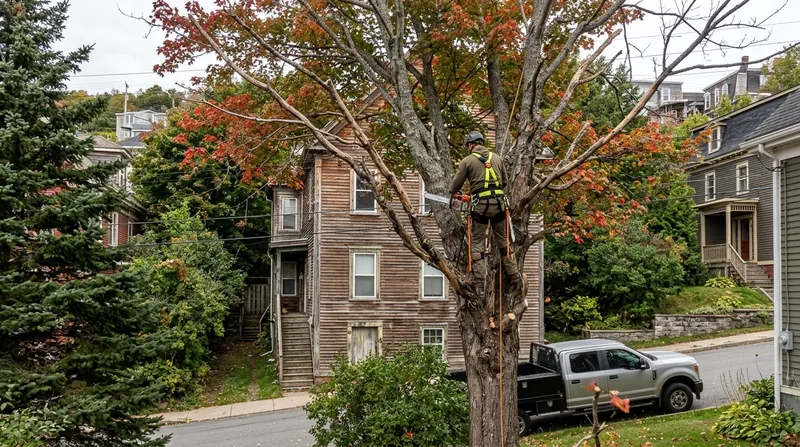




Dead, broken and hanging branches do not wait for a convenient moment. Deadwood removal in Saint John clears that material out of mature canopies before the next ice storm, windstorm or heavy snowfall brings it down on a roof, a parked car or a walkway. Our crews have worked the ravine lots, the tight backyards and the post-war street trees of this city since 2014, and we know how silver maple and red oak fail when a limb has been dead for two or three seasons. We are a local, fully insured company with ISA Certified Arborists on staff. Every visit starts with a free estimate and a clear scope: which limbs come out, how they are lowered and how the debris leaves your property. If you want the wider picture on canopy care, start with our tree trimming service page and come back here for the deadwood work.
Why deadwood is a real liability on a mature canopy
A dead branch loses flexibility before it loses weight. In a silver maple or a red oak, the attachment point decays from the inside while the limb still looks solid from the ground. Saint John winters load that wood with snow and ice, and a summer windstorm does the rest. The risk is not only the limb itself: a falling branch tears live tissue on the way down and opens the trunk to decay.
- Dead limbs drop without warning, often on the calm day after a storm rather than during it.
- Hangers caught in the crown can stay suspended for months and fall on a later visit to the yard.
- Decay spreads from a broken stub into the main stem and shortens the life of the tree.
- Deadwood over a driveway or a service entrance puts people and property in the drop zone.
Removing that material early costs far less than repairing a roof or a vehicle after a failure.
Key fact: a mature silver maple in Saint John West can carry 10 to 15 dead limbs after one ice event, and a single 3-metre limb falling from 12 metres reaches the ground with enough force to crush a car roof. A half-day of deadwood removal is cheap compared with that repair.
For the official context on tree care and urban forestry in in Saint John and the surrounding area, see Forestry and Land Management, Government of in Saint John and the surrounding area.
How our crews remove deadwood from a mature tree
Every job follows the same sequence, whether the tree stands in a Fairville backyard or on a ravine lot with steep access. We assess the crown from the ground and from within the canopy, identify the deadwood and the live structure that supports it, then plan the drop zone before anyone climbs. Nothing is cut until the rigging and the landing area are set.
- We inspect the tree from the ground, check the root flare and the main crotches, and note every dead limb and hanger.
- We set the drop zone, protect the lawn or driveway with mats, and confirm the location of the private service entrance.
- A climber works the crown with a handsaw and a top-handled saw, lowering each piece on a rope rather than dropping it.
- We make the final cut at the branch collar so the tree can seal the wound on its own.
- We clear the debris, chip the small material and leave the firewood-sized pieces where you want them.
The result is a cleaner crown, fewer failure points and a tree that can close its wounds instead of decaying further.
Key fact: on a Grand Bay-Westfield property with a Norway spruce and two red oaks, a recent deadwood job removed 22 limbs in one morning. The homeowner kept the wood, and the chips went to a garden bed on site. No truck left the driveway loaded.
If the deadwood sits in a tree that also needs structural correction, our tree pruning service covers the selective cuts that keep the remaining crown balanced.
Methods we use, and when each one applies
Not every dead limb comes down the same way. The choice depends on the height, the rigging options, the drop zone below and the condition of the wood. We pick the method that gets the material on the ground without damaging what is underneath.
| Method | Description | Context |
|---|---|---|
| Hand saw and pole saw | Small dead limbs cut from the ground or from a low ladder-free position. | Street trees and small ornamentals with light deadwood. |
| Climbing and rigging | A climber works the crown and lowers each limb on a rope. | Mature maples and oaks over roofs, driveways or fences. |
| Bucket truck access | An aerial lift reaches the crown where the ground allows a truck to set up. | Open front yards and wide lanes in post-war subdivisions. |
| Controlled drop | A dead limb is cut and dropped into a cleared, protected landing zone. | Ravine lots and backyards with no rigging anchor above. |
| Hanger retrieval | A suspended limb is secured and lowered before it can fall. | After ice storms and windstorms, when broken limbs stay caught in the crown. |
We confirm the method on site during the free estimate, so you know in advance how the work will be done.
Permits, clearances and debris handling in the Saint John area
Deadwood removal on a live private tree rarely triggers a permit on its own, but the City of Saint John may require a permit for a private tree removal, and that application is normally supported by an arborist report. Rules and thresholds differ from one municipality to the next across the Saint John area, so we check the local requirement before the crew arrives. Near a private electrical service entrance, we respect the required approach distances, and any tree touching the public distribution network is referred to NB Power, which owns and maintains those lines.
Debris handling is part of the job. Small branches go through the chipper, the chips can stay on site as mulch, and firewood-sized pieces are cut to length and stacked where you want them. We leave the lawn raked and the driveway blown clean. For larger volumes, our brush chipping service takes the material away in one pass.
When a dead tree is beyond saving, the next step is a full removal, covered on our tree removal page. If a limb has already come down after a storm, our storm damage cleanup service handles the emergency side.
For planning and budgeting, the full pricing grid lists typical ranges, and the arborist report service covers the documentation a permit application may need.
Prices Deadwood Removal in Saint John — Indicative pricing
| Service | Price | Details |
|---|---|---|
| Small tree, light deadwood | From $225 | Up to 8 metres, hand tools, debris chipped and removed |
| Medium tree, moderate deadwood | From $425 | Climbing and rigging, drop zone protection included |
| Large mature tree, heavy deadwood | From $750 | Rigging over structures, multiple hangers, full cleanup |
| Multiple trees on one property | From $1,150 | Crew of two or three, same-day completion where access allows |
| Travel | Included | In Saint John and the surrounding area |
| Free estimate | Free | Reply within 24 hours at (506) 719-5415 |
Indicative prices; free, personalized estimate within 24h at (506) 719-5415.