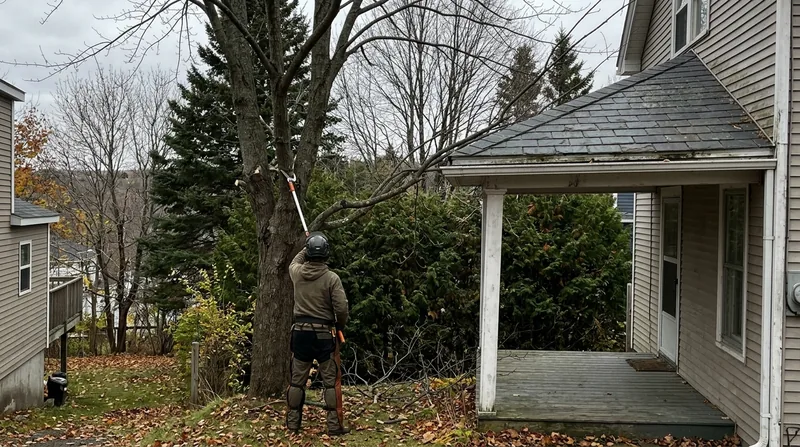




Tree pruning in Saint John is selective work, not a haircut. Our crews remove deadwood, weak unions and rubbing branches so a tree keeps its shape and gains years of useful life. In a city where silver maple, red oak and ash line the older streets and cedars mark almost every property line, the difference between a proper prune and a topping cut shows up within two seasons. We have worked the ravines, tight backyards and post-war subdivisions of the Saint John area since 2014, and our ISA Certified Arborists assess every tree before a saw starts. If you want the wider picture on canopy care across the property, start with our tree trimming service and we will point you to the right scope.
Why structural pruning matters more here than in a mild climate
Saint John sits on the Bay of Fundy, and the freeze-thaw cycles that come with it open cracks in bark and split weak crotches. A silver maple with two codominant leaders over a driveway in Saint John West is a real risk once an ice storm loads the branches. Pruning early removes that risk at the source instead of paying for it after a windstorm.
- We remove dead, dying and diseased wood before it drops on a roof or a fence.
- We correct weak unions and included bark on maples and oaks while the tree is still young.
- We thin the canopy on mature street trees so wind passes through instead of levering the trunk.
- We clear branches away from private service entrance wires without ever touching the public distribution network.
Each cut is chosen for the tree's long-term structure, not for how fast the job can be finished. For the standards behind that approach, the International Society of Arboriculture publishes its pruning guidance at isa-arbor.com.
Key fact: a mature silver maple in a Grand Bay-Westfield backyard typically needs 2 to 4 hours of selective pruning, and the debris from one tree often fills a 6 cubic metre chip truck. We chip on site and leave the property clean the same day.
How our arborists carry out pruning in the Saint John area
Every job starts with a walk-around. We look at species, lean, root flare and the targets below the canopy, then agree on the scope with you before any line goes up. In tight backyards off the Lower West Side, that assessment decides whether we climb or use a lift, because access through a standard gate changes the whole plan.
- We inspect the tree and record defects, deadwood and clearance needs.
- We set up rigging and drop areas away from fences, sheds and service entrance wires.
- We make the pruning cuts in the correct order, starting with the deadwood and the lowest limbs.
- We treat every wound site with a clean cut and leave the branch collar intact.
- We chip the brush, rake the ground and walk the property with you before leaving.
You get a written scope and a clean site, and you know exactly which trees were worked on. For larger properties where pruning is only part of the job, see our tree removal service so both options are priced side by side.
Key fact: on a ravine lot in the Saint John area, a single red oak may need a climb line, a rigging line and two ground crew. That setup runs 3 to 5 hours for a full structural prune, compared with 90 minutes for the same tree on flat ground.
Pruning methods we use, and when each one fits
The right method depends on the species, the age of the tree and what sits underneath it. We choose between them on site, and we explain the trade-offs before we start. The table below shows the four approaches our crews use most often in Saint John neighbourhoods.
| Method | Description | Context |
|---|---|---|
| Crown cleaning | Removal of dead, broken and diseased limbs | Mature street trees after an ice storm |
| Crown thinning | Selective removal of interior branches to improve airflow | Dense maples and oaks over roofs |
| Structural pruning | Training young trees to one leader and strong unions | New plantings and post-war subdivision trees |
| Crown reduction | Controlled shortening of limbs back to a lateral branch | Trees crowding a house or a private service entrance |
Each method has a season and a limit, and we tell you when a tree is better left alone than cut. For a full price breakdown by method and tree size, the pricing page lists our current rates.
What surrounds a pruning job: permits, wires and debris
Pruning rarely needs a permit, but the City of Saint John may require one for a private tree removal, and an arborist report normally supports that application. We tell you at the estimate stage whether your project crosses that line. Near private electrical service entrances, we respect approach distances and never touch the public distribution network: a limb on NB Power's lines is referred to NB Power. Brush and wood are chipped on site, and firewood can be left cut and split if you want it.
Rules and thresholds differ from one municipality to the next across the Saint John area, so a job in Grand Bay-Westfield is not assessed the same way as one in Saint John West. We check the local requirement before scheduling, and we put the scope in writing. Our arborist report service covers the documentation when a permit or a neighbour dispute requires it.
Species and timing: what we prune, and when
Dormancy is the safe window for most structural work in in Saint John and the surrounding area. Late fall to late winter lets us see the branch structure without leaves and reduces stress on the tree. Maples and birches bleed heavily in spring, so we schedule them accordingly. Ash killed by the emerald ash borer is a separate case: it becomes brittle fast and often needs removal rather than pruning.
- We prune silver and sugar maples in dormancy to limit sap loss and disease entry.
- We inspect ash for emerald ash borer signs and recommend protection or removal.
- We leave oak pruning for the cold months to reduce the risk of oak wilt spread.
- We prune fruit trees on a separate calendar, which our fruit tree pruning service explains in detail.
Timing is not a detail here: a cut made in the wrong month can cost a tree years of growth. If a limb is already broken or hanging after a windstorm, do not wait for the season, call emergency tree removal and we will secure the site.
Key fact: a Norway spruce hedge line in Fairville that has not been pruned in five years can take a full day to bring back into shape, while the same work on a three-year cycle takes about 3 hours. Regular pruning costs less per visit and keeps the tree healthier.
When to book pruning, and what it costs
Most homeowners in Saint John book pruning between November and March, when the crew can work without foliage and the ground is firm. Small ornamental trees start at $225, and a full structural prune on a mature maple runs from $650 to $1,200 depending on access and height. We confirm the price on site, in writing, before any work begins.
If you are comparing two or three companies, ask each one for proof of insurance and for the name of the arborist who will assess the tree. That single question separates a pruning contractor from a crew that tops trees. Reach us at (506) 719-5415 or through the contact page to book a free estimate.
Prices Tree Pruning in Saint John — Indicative pricing
| Service | Price | Details |
|---|---|---|
| Small ornamental tree pruning | From $225 | Up to 6 metres, deadwood and shape |
| Medium tree structural prune | From $450 | 6 to 12 metres, crown cleaning and thinning |
| Large mature tree prune | From $650 to $1,200 | Over 12 metres, rigging and access included |
| Ravine or tight-access lot | Quoted on site | Free assessment of access and rigging needs |
| Travel | Included | In Saint John and the surrounding area |
| Estimate | Free | Reply within 24 hours at (506) 719-5415 |
Indicative prices; free, personalized estimate within 24h at (506) 719-5415.