What Dorian and Lee Taught Saint John Homeowners
Post-tropical storm Dorian and hurricane Lee both tracked across New Brunswick within a few years of each other, and each one left a distinct signature on the urban forest in Saint John. Dorian arrived with sustained wind and heavy rain that saturated the clay soils common across the region, so trees that might otherwise have held simply tipped at the root plate. Lee brought a longer period of gusting wind that broke limbs and split leaders on mature maples and spruce. The damage patterns were different, but the lesson was the same: the trees most likely to fail were the ones that had never been inspected or maintained.
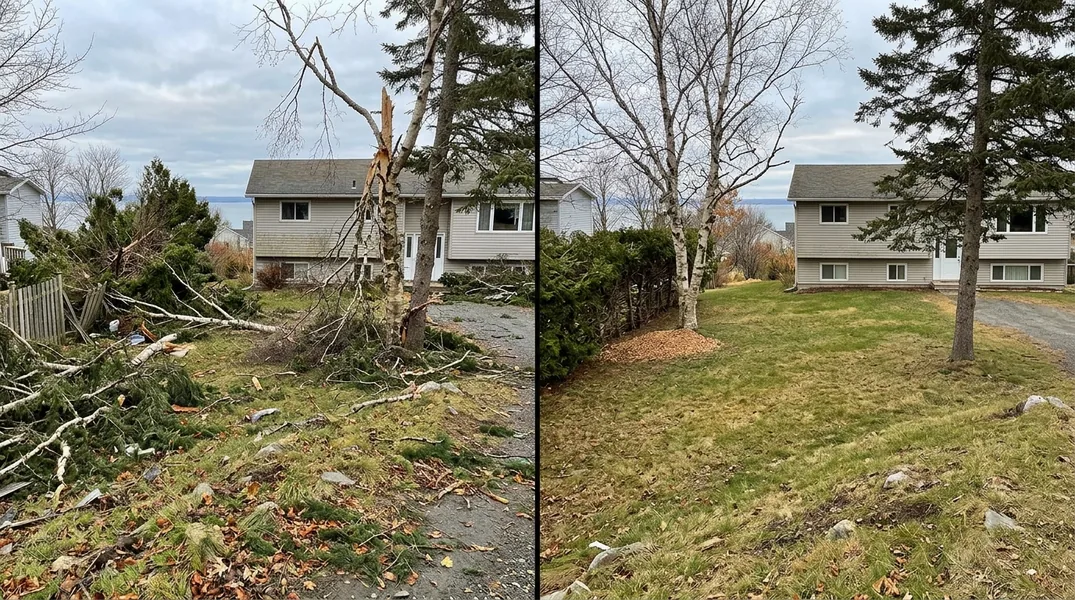
Homeowners across the city spent days dealing with fallen tree cleanup, blocked driveways and damaged fences. Some of that work could have been avoided with a proper tree risk assessment before the season began. Others faced emergency tree removal Saint John calls in the middle of the night when a compromised trunk leaned toward a house. Understanding how these storms affect trees is the first step toward protecting your property the next time a system moves up the Bay of Fundy.
Reading the Damage: What a Storm Leaves Behind
Not every damaged tree looks dangerous, and not every tree that looks fine is safe. After a windstorm, the most obvious problems are uprooted trees, hanging limbs and split trunks, but the more serious hazards are often subtler. A crack that runs down the crotch of a mature maple, a cavity hidden behind ivy, or a root plate that has lifted a few centimetres out of the soil can all signal a tree that is one gust away from failure. Hurricane tree damage frequently shows up as internal decay that only becomes visible months later when a limb drops on a calm day.
Our ISA Certified Arborists start every post-storm inspection with a tree risk assessment that looks at lean, soil heave, canopy density, deadwood and the condition of the main unions. We also check the private service entrance wire that runs from the utility pole to your house, because a limb resting on that line is a genuine hazard. We do not work on the public medium- or high-voltage distribution network operated by NB Power; that is the utility's responsibility. We do handle clearance around your own service entrance, respecting the required approach distances, and we coordinate with NB Power when a line needs to be de-energized before work begins.
When a Tree Has to Come Down
Some storm-damaged trees can be saved with careful Tree Pruning that removes broken limbs and rebalances the canopy. Others cannot. A tree with more than half its crown lost, a split trunk that extends below the first major branch, or a root system that has been lifted and torn is usually a candidate for Tree Removal. Leaving a compromised tree standing puts your home, your vehicle and your neighbours at risk, and it can complicate any future insurance claim if the hazard was known and ignored.
Emergency tree removal Saint John residents call us for is often a tree that is already leaning over a structure or blocking access. In those cases we assess the scene, isolate the work area and bring the tree down in controlled sections rather than felling it in one piece. Once the wood is down, fallen tree cleanup includes chipping the brush, hauling the debris and, where the stump is in the way of a new planting or a driveway, Stump Grinding to below grade. If you are comparing options, our rates page outlines how we scope this kind of work.
Building a Storm-Proof Yard Before the Next System
Storm proof trees are not a myth. The work starts with structural pruning on young and middle-aged trees so that the canopy develops strong central leaders and well-spaced limbs. On mature trees, thinning the canopy reduces wind sail and lets gusts pass through rather than catching the whole crown. Removing deadwood, crossing branches and weak unions before the season turns is far cheaper than emergency work after a storm. Cabling and bracing can also support a tree with a historically weak crotch, provided the tree is otherwise sound.
Species selection matters too. Spruce and cedar hedges are common across the region and can be damaged by heavy snow and ice, while maples and oaks need room to develop. On ravine lots and properties with New Brunswick clay soils, drainage and root space are just as important as what happens above ground. A Tree Trimming schedule every two to three years, adjusted for species and growth rate, keeps your trees in a condition that can handle a post-tropical storm far better than a neglected canopy. Homeowners in Saint John West (Saint John) and Fairville (Saint John) deal with the same wind exposure and the same clay, so the advice is consistent across the city.
Permits, Insurance and Documentation
The City of Saint John may require a permit for a private tree removal, and an arborist report supports that application. This is one of the practical reasons to work with a company that documents its findings. If a tree on your property is damaged and you plan to remove it, having a written assessment before the work begins makes the permitting process smoother and gives you a record of the condition of the tree at the time of inspection. We can prepare that report as part of a broader assessment of your property.
For insurance purposes, we document the damage with photographs and notes so that you have a clear record to submit to your insurer. We do not decide coverage, and we never promise that a claim will be paid, but a well-documented file is what your adjuster will ask for. If a storm brings a tree down on a fence, a shed or a vehicle, the same documentation supports the cleanup and removal work. Homeowners in Lower West Side (Saint John) and other neighbourhoods with older housing stock often find that the paperwork matters as much as the chainsaw work.
Book a Pre-Season Assessment
The best time to think about the next post-tropical storm is before it forms. A pre-season walk-through with one of our ISA Certified Arborists identifies the trees that need pruning, the ones that need removal and the ones that are fine as they are. We provide a free estimate for any recommended work, and we can schedule trimming and removal in the weeks that suit you rather than in the middle of a cleanup emergency. Saint John Tree Trimming Co. is a local, fully insured company serving the city and the surrounding municipalities.
If you have a tree that concerns you after recent wind, or you simply want a plan in place for the season ahead, call (506) 719-5415 or request a free quote. Our crews handle tree trimming, tree removal, stump grinding and storm damage cleanup across Saint John, and we will tell you plainly what needs to be done and what can wait.
Looking for a professional in Saint John? Saint John Tree Trimming Co. responds quickly for all your tree trimming needs.
Get a free estimateOur services : Tree Trimming · Tree Removal · Stump Grinding