Why Trees on the Fundy Coast Face a Different Set of Challenges
If you own property near the water in Saint John, you already know that growing trees here is not the same as growing them inland. The Bay of Fundy delivers a steady dose of salt-laden wind, frequent fog and weather that can shift from calm to punishing within an hour. Those conditions shape every tree on your lot, from the spruce at the back line to the cedar hedge along the driveway.
Salt spray is the first stressor most homeowners notice. Airborne salt crystals settle on needles and leaves, drawing moisture out of the tissue and causing what arborists call salt burn. On spruce and fir, you will see browning on the windward side, usually the side facing the water. Over time, repeated exposure weakens the tree's ability to photosynthesize and leaves it more vulnerable to pests and disease. This is why Tree Pruning on the coast has to account for direction and timing, not just shape.
Rocky soil is the second challenge. Much of the ground around Saint John is thin, stony and fast-draining, which means trees have less room to anchor and less reserve moisture during dry spells. A spruce that looks healthy above ground may have a surprisingly shallow root plate, and that matters enormously when wind hits. Understanding how your soil holds, or fails to hold, a root system is the starting point for any real coastal tree care plan.
Salt Spray Damage: What It Looks Like and What You Can Do
Salt spray trees show damage in predictable ways. Needles on the exposed side turn brown or reddish, often from the tip inward. Deciduous trees may leaf out late, show scorched margins on the leaves, or drop foliage early in the season. If you see these symptoms year after year, the tree is not adapting; it is declining slowly. Catching that pattern early is where a certified arborist earns their keep.
Management starts with selective Tree Trimming to remove dead and dying material and to reduce the surface area exposed to wind-driven salt. On hedges and evergreens, we often recommend planting or maintaining a hardier windward buffer, such as cedar or native spruce, so that more sensitive specimens sit in their lee. Deep watering during dry periods helps flush salt from the soil profile, and avoiding fertilizer high in chloride keeps the problem from getting worse.
It is worth saying plainly: no amount of pruning will make a salt-sensitive species thrive ten metres from the water. Part of our job is telling homeowners which trees are worth investing in and which ones are better replaced with something suited to the exposure. That honest assessment saves money over a decade of chasing a losing battle.
Wind Damage and Storm Risk on Exposed Lots
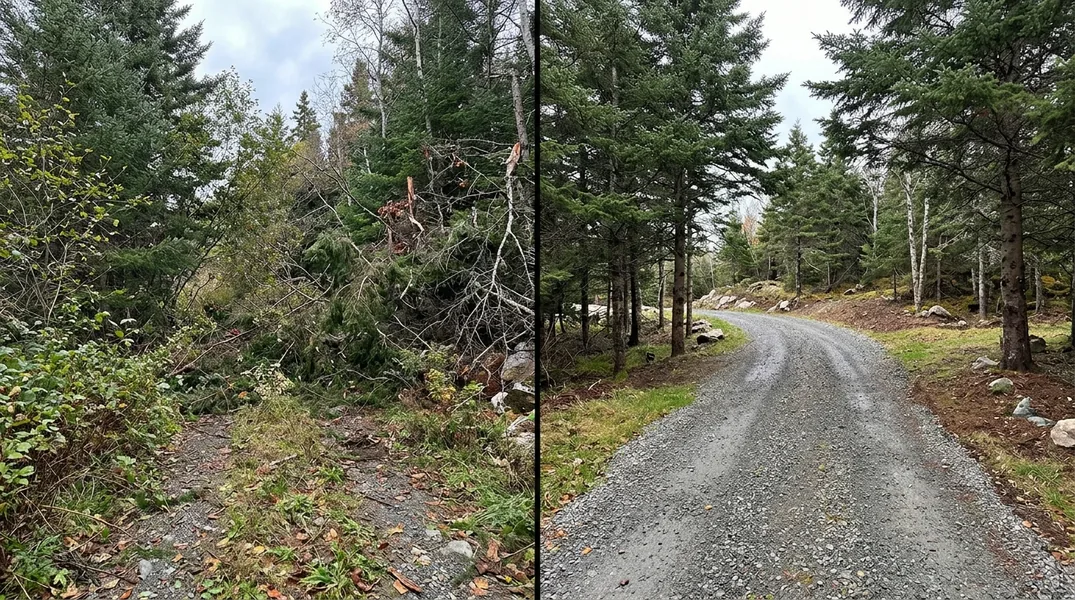
Wind damage trees in Saint John are a recurring reality, and the Fundy coast amplifies it. Sustained onshore wind, combined with freeze-thaw cycles that heave the ground in late winter, puts real stress on root plates. Add a shallow rocky substrate and you get trees that lean, crack at the crotch, or fail outright during a windstorm. The damage is not always dramatic at first; a small crack at a branch union can take two or three seasons to become a hazard.
Structural pruning is the most effective preventive measure. By thinning the crown and reducing end weight on long limbs, we lower the leverage that wind applies to the trunk and roots. Cabling and bracing can support a valuable tree with a weak union, though it is not a substitute for removal when the risk is genuinely high. After a storm, our crews assess what can be saved and what has to come down, and we document the damage for your insurer if a claim is in play.
When a tree is beyond saving or has already failed, Tree Removal has to be done with rigging and care, especially on tight coastal lots where a dropped trunk could take out a fence, a shed or a service line. We work around the private service entrance to your home, coordinating with NB Power where the wire from the pole is involved. We do not work on the public distribution network itself; that is NB Power's responsibility, and we say so clearly.
Spruce Care in New Brunswick: The Coast's Workhorse Tree
Spruce care in New Brunswick deserves its own section because spruce is the backbone of most coastal properties here. White spruce and red spruce tolerate salt and wind better than most alternatives, but they are not indestructible. They are prone to cytospora canker, a fungal disease that kills lower branches and spreads upward, and to spruce budworm in outbreak years. Both problems are easier to manage when the tree is properly thinned and air can move through the canopy.
Our approach to spruce is conservative. We remove dead wood, thin overcrowded leaders, and correct co-dominant stems before they split. We avoid heavy pruning in late summer, when wounds heal slowly, and we do not top spruce, a practice that ruins form and invites decay. If you have a row of spruce along the shore, periodic inspection after winter is the single most useful habit you can build. A tree that has lost its leader or developed a lean needs attention before the next windstorm, not after.
Rocky Soil, Planting and the Long Game
Trees on rocky soil need help that inland gardeners rarely think about. Because the rooting volume is limited, mulch rings, careful watering and avoiding compaction around the drip line make a measurable difference. We often recommend a wider mulch bed than usual and a light layer of organic matter worked into the top few centimetres, without burying the root flare. Driving or parking over the root zone of a coastal tree is one of the fastest ways to shorten its life.
For homeowners planning replacements, species selection matters more than any maintenance regime. Native spruce, cedar and certain birch do well in exposed coastal conditions; maples and other sensitive hardwoods are better placed in sheltered pockets. If you are clearing a site for a new build or a driveway, Stump Grinding lets you reclaim the ground without hauling out the whole root ball, which is often impractical on stone-heavy lots. Our team can walk your property and recommend a planting plan that suits the exposure, the soil and your budget. You can request a free estimate through our quote page or call (506) 719-5415.
Working With a Local Arborist in Saint John
Coastal tree care rewards local knowledge. An arborist who works the Fundy shore every week knows which exposures burn, which soils drain too fast, and which species hold up after a February gale. Saint John Tree Trimming Co. is a local, fully insured company with ISA Certified Arborists on staff, and we serve homeowners across Saint John West (Saint John), Lower West Side (Saint John), Fairville (Saint John) and the surrounding neighbourhoods.
Before any work begins, we assess the tree, the soil and the exposure, and we explain the options in plain terms. If a permit may be required for a private tree removal, we tell you and help you understand what the City of Saint John expects; an arborist report is often part of that conversation and we can prepare one. Our rates are quoted up front, and cleanup is included. Whether you need a single storm-damaged limb removed or a full coastal property plan, the first step is a conversation. Call (506) 719-5415 or reach out online to book a free estimate.
Looking for a professional in Saint John? Saint John Tree Trimming Co. responds quickly for all your tree trimming needs.
Get a free estimateOur services : Tree Trimming · Tree Removal · Stump Grinding